
Dose vs Directions on a Label: What’s the Difference?

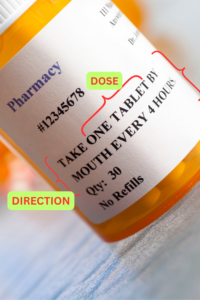 Medication labels are small, but they carry a lot of responsibility. Sometimes one tiny sentence on the bottle is expected to explain what to take, how much to take, when to take it, and what special instructions to follow.
No pressure, little label.
One common point of confusion is the difference between the dose and the directions. They are connected, but they are not exactly the same thing.
A simple way to remember it is this:
The dose tells you how much.
The directions tell you how to use it.
That difference may sound small, but it can matter when you are trying to follow a medication routine safely.
What Does “Dose” Mean?
The dose is usually the amount of medication you are supposed to take at one time.
Depending on the medication, the dose may be written in different ways. It might be one tablet, two capsules, 5 mL of liquid, one patch, two puffs, one drop, or another specific amount.
The dose answers the question:
“How much do I take?”
For example, if a label says “Take 1 tablet,” the dose is one tablet.
If a liquid medicine label says “Take 5 mL,” the dose is 5 mL.
If an inhaler label says “Use 2 puffs,” the dose is two puffs.
The exact wording can vary, but the dose is the amount part.
This is also where people can sometimes mix up strength and dose. The strength may be printed as something like 250 mg, 500 mg, or another amount. That number describes how strong each tablet, capsule, or measured amount may be. It does not always tell the full story of how the medication should be taken.
That is why reading the full directions matters.
What Do “Directions” Mean?
The directions are the full instructions for how the medication should be used.
Directions may include:
- How much to take
- When to take it
- How often to take it
- Whether to take it with food
- Whether to take it at bedtime
- Whether it is only taken when needed
- How long to use it
- Any special instructions from the prescriber or pharmacy
The directions answer the bigger question:
“How do I take this properly?”
For example, “Take 1 tablet by mouth twice daily with food” includes more than just the dose.
The dose is 1 tablet.
The directions also tell you the route, the frequency, and the food instruction.
That one sentence is doing a lot. It deserves a little respect and maybe a tiny chair.
Why This Difference Matters
Dose and directions can be confusing because they often appear in the same sentence. But guessing from only one part of the label can lead to misunderstanding.
For example, someone may notice “1 tablet” and stop reading. But the rest of the directions may say once daily, twice daily, at bedtime, with food, or only when needed.
Those details matter.
Health Canada advises using medication as directed by your doctor or pharmacist and reading the product label closely.
Another person may focus on a number like 500 mg and assume that is the instruction. But the full label may say whether to take one tablet, when to take it, and how often.
That is why it is helpful to slow down and read the full label before using the medication.
A Simple Medication Label Check
When you look at a medication label, try asking yourself these questions:
- What is the medication name?
- What is the strength, if listed?
- What is the dose?
- How often should it be taken?
- When should it be taken?
- Are there food, storage, or warning instructions?
- Do I understand what to do if I miss a dose?
The CDC also recommends taking medicines as directed on the label or as instructed by a doctor or pharmacist.
You do not need to become a label detective with a trench coat and theme music. You just need to make sure the main instructions make sense before you take the medication.
Keeping medicines in their original containers can also make label information easier to check.
When the Label and Your Memory Do Not Match
Sometimes a label may look different from what you expected.
Maybe your healthcare provider changed the dose. Maybe the pharmacy label has new directions. Maybe you received a refill and the wording looks different from last time. Maybe you were told something during an appointment, but the label seems unclear when you get home.
If the label directions do not match what you remember, contact the pharmacy or your healthcare provider before taking the medication. It is better to ask a simple question than to take medication in a way that may not be intended for you.
This is especially important if the medication is new, if the dose changed, if the directions changed, if the medicine is for a child, or if you take several medications.
Watch Out for “As Needed” Directions
Some medication labels include wording such as “as needed.” That means the medication may not be intended for a fixed schedule in the same way as a regular daily medication.
But “as needed” does not mean “whenever I feel like it, with a little creative confidence.”
The label may still include limits, timing, maximum amounts, or other instructions. If you do not understand how often you may take an “as needed” medication, ask before using it.
The same applies to labels that say things like “take with food,” “avoid alcohol,” “do not drive,” “shake well,” or “finish all medication unless told otherwise.” These instructions are not decoration. They are part of safe medication use.
A Helpful Habit Before Leaving the Pharmacy
Before leaving the pharmacy, take a few seconds to read the label.
Ask yourself:
- Do I understand the dose?
- Do I understand the directions?
- Do I know when and how often to take this?
- Do I know whether there are special instructions?
If the answer is no, ask the pharmacy team to explain. Questions are not annoying. Questions are part of safe medication use.
ISMP Canada’s 5 Questions to Ask About Your Medications can also help patients and caregivers prepare simple questions about medication use.
This habit can be especially helpful for caregivers picking up medicine for someone else. If you are picking up medication for a parent, child, spouse, or family member, check the person’s name, medication name, dose, and directions before you leave.
A small pause can prevent a lot of confusion later.
Dose vs Directions: The Simple Takeaway
Here is the simple difference:
Dose means how much.
Directions mean how to take it.
The dose may be one part of the directions, but the directions give the full instruction.
Before taking medication, read the whole label. Look for the amount, timing, frequency, route, and special instructions. If anything is unclear, ask your pharmacist or healthcare provider before guessing.
Medication safety does not have to be complicated. Sometimes it starts with reading the label slowly enough to let the tiny words do their big job.
Disclaimer
This post is for general health education only and is not medical advice. Medication instructions can vary depending on the medication, your health condition, age, allergies, other medications, and your healthcare provider’s plan. Always follow the instructions on your own medication label and speak with your pharmacist or healthcare provider if anything is unclear.